

 English
  Français
 Chunmee Tea Export: Quality and Packaging Requirements for Bulk Buyers
A 20-foot container holds roughly 6,000 to 7,000 kg of Chunmee packed in 20 kg cartons, and the whole consignment can be rejected on the strength of one figure in a laboratory report. When an importer in Casablanca opens a lot contracted at 7.0 percent maximum moisture and finds 7.4 percent, the rejection is contractual, not commercial. The same applies to a residue result of 0.02 mg/kg where the destination market allows 0.01 mg/kg.
Chunmee tea export is a specification business. The leaf has to be grown, fired and sorted correctly, but a shipment only earns money when the quality parameters, the packaging and the paperwork all survive the voyage intact. This article sets out what experienced buyers write into purchase orders, and what exporters such as Hangzhou Baoda Tea Co., Ltd. verify before a container is sealed.
Quality Parameters That Decide Whether a Chunmee Lot Clears
Export-grade Chunmee is defined by ISO 11287:2011 (Green tea - Definition and basic requirements) and, in commercial contracts, by four figures that appear on every certificate of analysis: moisture at 7.0 percent maximum, water extract at 32 percent minimum, total ash at 7.5 percent maximum, and pesticide residues at or below the destination market limit.
Moisture causes most claims. Pan-fired green tea is hygroscopic, and above roughly 7 percent (m/m) the free water in the leaf supports mould growth and accelerates the oxidation that turns a bright olive liquor dull and flat. Moisture is determined by loss in mass at 103 degrees Celsius under ISO 1573.
| Parameter | Common contractual limit | Why buyers enforce it |
| Moisture content | 7.0% max (m/m) | Free water above this level supports mould and drives a stale, flat cup |
| Water extract | 32.0% min | Measures soluble solids; low extract means thin body and weak colour |
| Total ash | 7.5% max | Elevated ash points to soil, dust or excessive stalk in the lot |
| Crude fibre | 16.5% max | Flags coarse leaf and stem that dilute the declared grade |
| Powder content | 1.0% max | Dust escapes the leaf and settles as waste in the carton |
| Pesticide residues | 0.01 mg/kg default MRL in the EU and Morocco | One exceedance rejects the entire container |
| Anthraquinone | 0.02 mg/kg (EU) | Forms from combustion gases during drying, not from spraying |
| Lead and cadmium | 5.0 mg/kg and 1.0 mg/kg (EU Regulation (EU) 2023/915) | Soil uptake, rising with roadside drying and low soil pH |
Residues are judged against the market of destination, not the country of origin. The European Union applies a default maximum residue limit of 0.01 mg/kg where no specific value is listed, and Morocco's ONSSA applies the same 0.01 mg/kg default. That is one part in one hundred million, so a multi-residue screen covering more than 500 active substances is the only defensible way to release a lot for shipment.
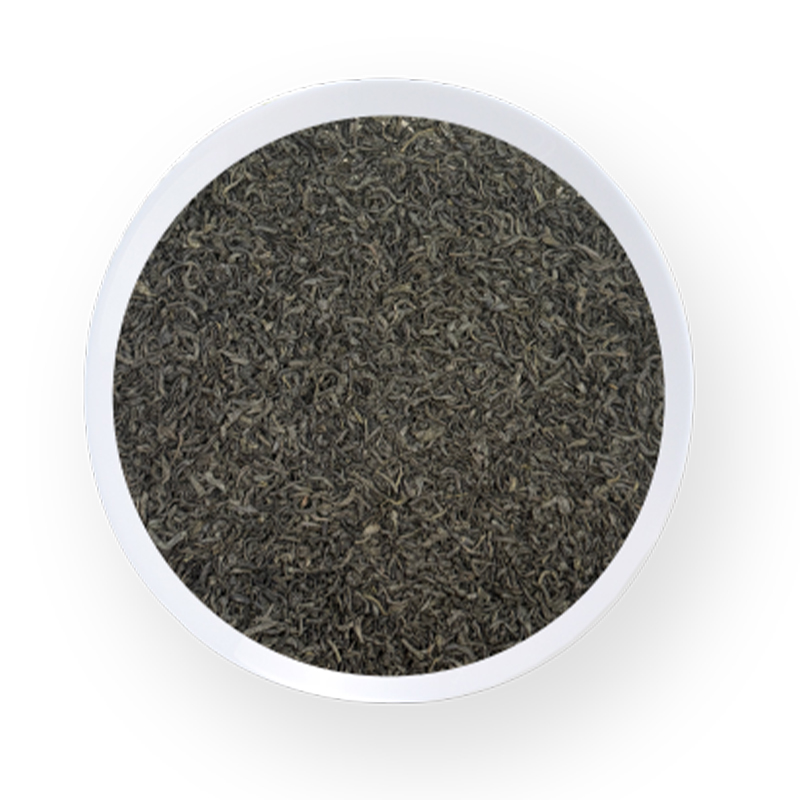
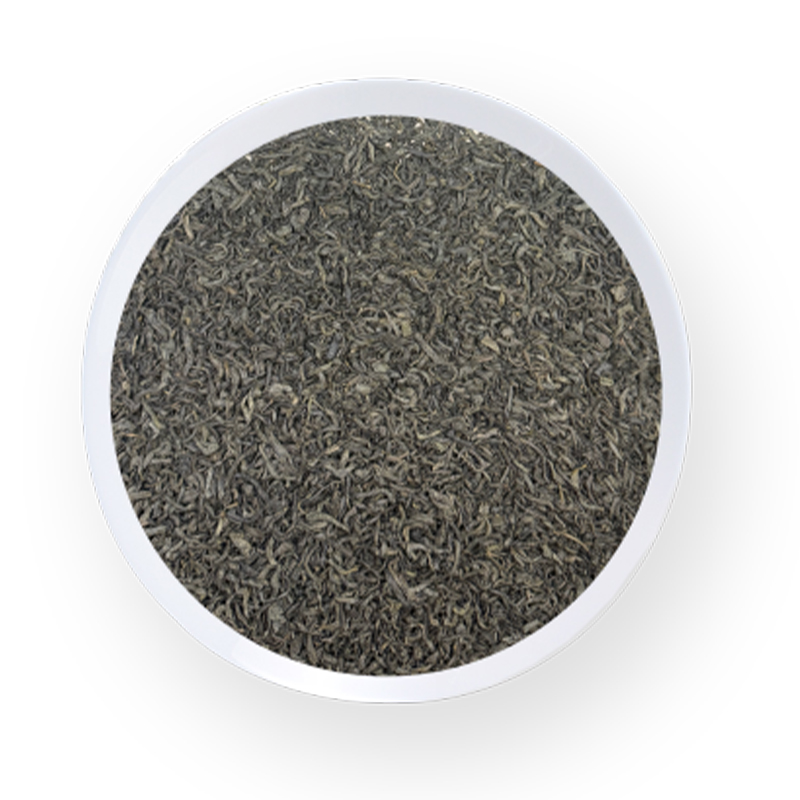
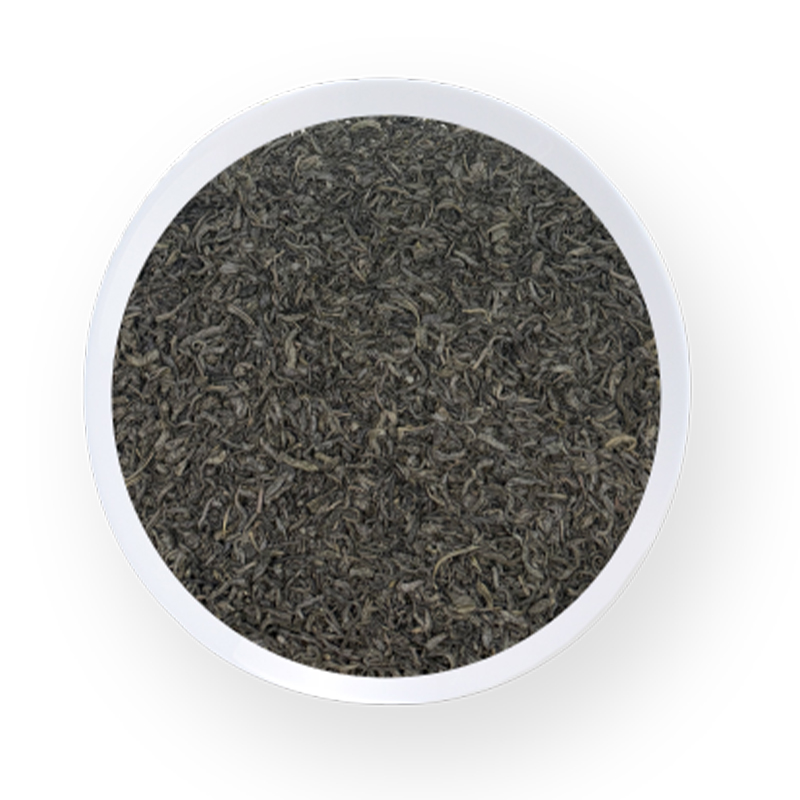
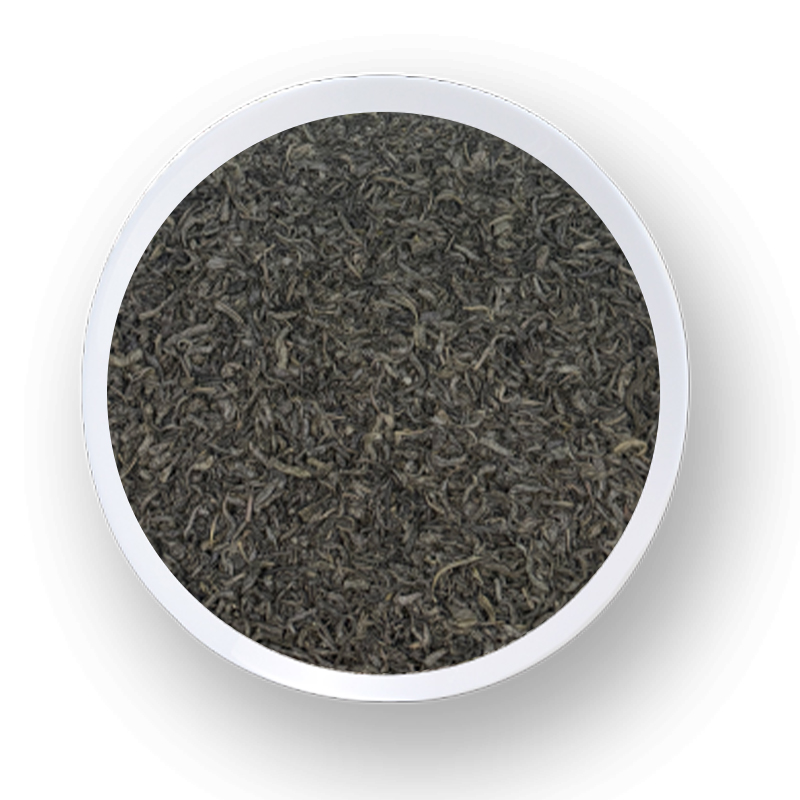
Chunmee, defined: Chunmee, also written Chun Mee or Zhenmei, is a pan-fired Chinese green tea whose leaf is rolled into a thin, curved strip shaped like an eyebrow. It is a standard bulk green tea of the African and European trade rather than a speciality product, and it is traded by lot number and grade letter.
Lot Numbers and Grade Letters in the Chunmee Trade
In the Chinese export numbering system the number identifies the style and the trailing letters identify the grade: 41022 is the classic Chunmee style, and Hangzhou Baoda Tea Co., Ltd. supplies it in eight letter grades from 41022 AAA through 41022 AAAAAAAA, plus 41022 Diamond, alongside the separate lots 4011, 9366, 9371 and 9380.
A higher letter count signals a finer sort and a larger share of tender leaf and tip. That shows up as a thinner, brighter strip, a more aromatic dry leaf and a softer cup. What it does not change is chemistry: a AAA lot and an AAAAAAAA lot from the same factory still have to pass the same ISO 11287 parameters and the same residue limits.
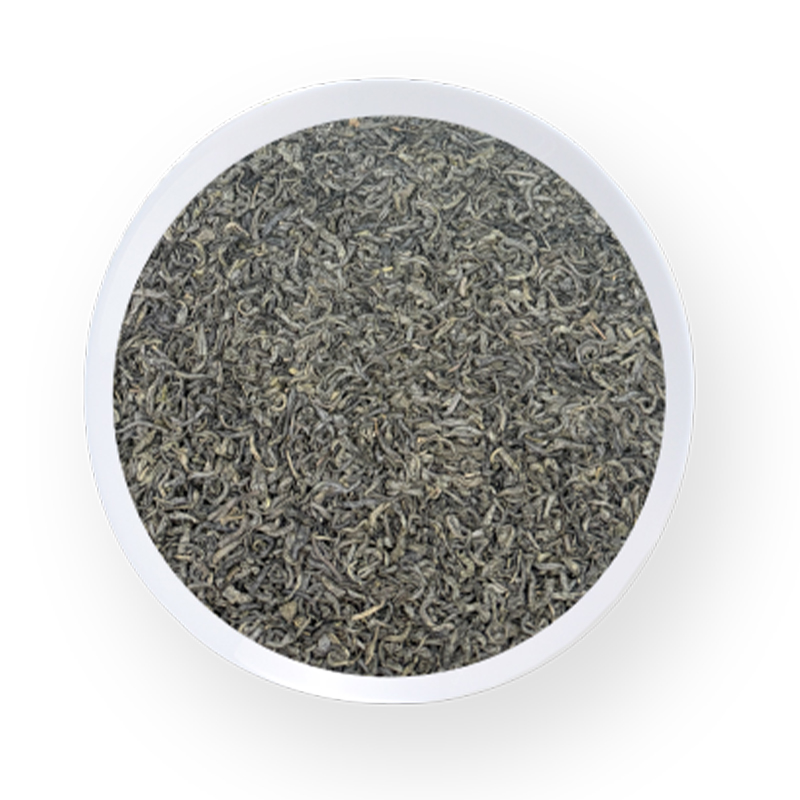 Chunmee 41022 AAAAA5A ·Material: one bud and two leaves, some three-leaf buds ·Features: thick and strong tea leaves, deep yellow soup, mellow taste, strong resistance to brewing ·Positi...View Product →
 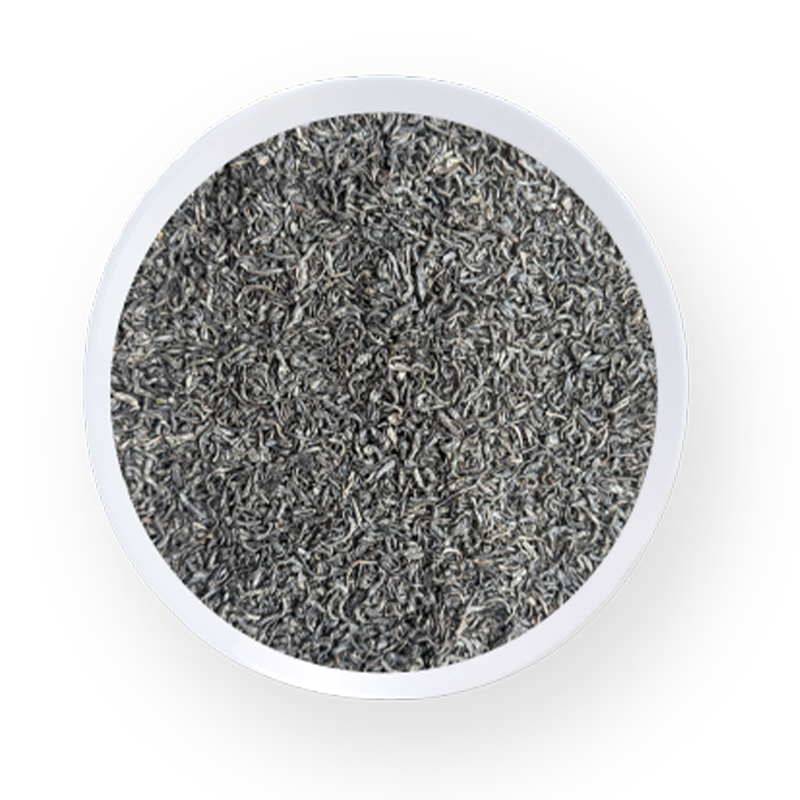 Chunmee 41022 Diamond41022 Chunmee, also known as premium Chunmee tea, is a fine product among Chinese green teas. It is famous for its "diamond quality" exported to Europe and global mark...View Product →
| Grade group | What the letter count signals | Typical buying decision |
| 41022 AAA and AAAA | Entry sorts with a larger leaf fraction and higher yield per kilo | Price-driven blending and value retail packs |
| 41022 AAAAA and AAAAAA | Mid sorts balancing aroma with body | Branded retail and food service |
| 41022 AAAAAAA and AAAAAAAA | Finest sorts with the highest tip content | Premium retail and gift ranges |
| 41022 Diamond | Top of the grade ladder for the 41022 style | Highest-value contracts, always sample-first |
| 4011 | A separate classic Chunmee lot with a different leaf style | Buyers matching an existing blend recipe |
| 9366, 9371, 9380 | Lots from different producing areas with distinct cup character | Blenders who need a specific regional profile |
Fix the chemical specification in the contract, not the letter count. ISO 11287 does not define A-grades, so a letter count on its own gives a buyer no enforceable quality position. Write moisture, ash, extract, powder and residue limits into the purchase order and name the sampling method and the testing laboratory.
Packaging Requirements for Bulk Chunmee
Bulk Chunmee for export is packed in food-grade units of 20 kg or 25 kg with a sealed inner moisture barrier, and the pack has to survive container temperatures approaching 60 degrees Celsius, a 25 to 35 day sea voyage, and stacking eight to ten units high.
| Packing format | Typical net weight | Where it fits | What to watch |
| Multi-wall kraft sack with 0.05 mm PE liner | 25 kg | Full container loads to Morocco and West Africa | Liner must be heat-sealed, not folded and taped |
| Corrugated carton with foil laminate liner | 20 kg | Palletised deliveries and mixed loads | Virgin kraft board only; recycled board carries odour |
| Heavy-duty sack or jumbo bag | 40 kg | Re-processing and blending plants | Liners puncture when sacks are handled by hook |
| Foil pouch, retail-ready | 250 g to 500 g | Private label programmes in the EU | Destination labelling must be fixed before packing |
| Nitrogen-flushed pouch or drum | 1 kg to 20 kg | Fine grades and long-storage contracts | Adds cost per kilo; justified beyond 12 months storage |
Packaging that clears inspection
- Heat-sealed 0.05 mm food-grade inner liner on every unit
- Virgin kraft cartons, palletised on ISPM 15 heat-treated pallets
- Container lined with kraft paper and fitted with desiccant bags
- Single-lot loading with the lot code printed on each carton
Packaging that triggers claims
- Folded liner closed with adhesive tape instead of a heat seal
- Recycled or heavily printed board that transfers odour
- Containers previously used for spices, detergent or chemicals
- Mixed lots loaded together without a segregation record
Temperature exposure in an unventilated steel container
Typical temperature ranges reported for unventilated steel containers in summer conditions, with warehouse and recommended storage values shown for comparison.
Two packaging details separate a clean delivery from a claim. First, the liner. A 0.05 mm food-grade polyethylene liner that is heat-sealed holds the tea below 7 percent moisture even when the container interior reaches 60 degrees Celsius; a folded liner lets humid air circulate with every temperature swing. Second, odour control. Green tea absorbs volatile compounds through the carton, which is why the container must be inspected and declared clean before loading, and why cartons should never be stacked against the container doors where condensation collects.
Documents, Labelling and Border Compliance
Five documents have to be complete before the container is sealed: the commercial invoice and packing list, the certificate of origin, the phytosanitary certificate, the health certificate, and a certificate of analysis tied to the lot code. The Chinese exporter itself must be filed with the General Administration of Customs under Decree 249 before it may export food.
- Confirm the supplier's export filing under GACC Decree 249, effective 1 January 2022, and keep a copy on file.
- Draw a composite sample from the blended lot and seal it with the lot code before the laboratory test, so the result can never be detached from the consignment.
- Test for moisture, water extract, total ash, crude fibre, powder, heavy metals and a multi-residue screen of more than 500 actives.
- Obtain the phytosanitary certificate from customs and the certificate of origin from the competent issuing body, matching invoice, packing list and bill of lading exactly.
- Print destination-compliant labels: name of the product, net quantity, best-before date, lot mark, storage conditions and the importer's name and address, as required by Regulation (EU) No 1169/2011 for European deliveries, with French and Arabic text for Morocco and Algeria.
- Inspect and line the container, load single-lot, seal it, and record the seal number against the lot code in the shipping file.
Traceability is a legal obligation, not a service. Under Regulation (EC) No 178/2002 the European importer must be able to identify the supplier of any tea lot one step back, and to show the buyer one step forward. An exporter who cannot link a carton to a production date and a field block cannot supply the EU market at all.
Documentary requirement for food placed on the EU marketQualifying a Chunmee Supplier Before the First Order
Qualify a Chunmee supplier on three lots drawn from three different production dates, each supported by a sealed 500 g sample and a third-party certificate of analysis issued within the last 90 days. One lot proves nothing, because a single blend can be assembled to pass once; three lots prove that a factory can repeat a specification across a season.
- Sealed 500 g samples with lot codes printed on the bag and repeated in the covering letter
- Third-party certificate of analysis less than 90 days old, naming the laboratory and the method
- A declared moisture value per lot, not a single annual range covering the whole year
- The inner liner specification in millimetres, stated in the contract rather than in email
- The tea grade and the plucking standard, with the sieve size used for sorting
- Container loading photographs for each shipment, taken after lining and before sealing
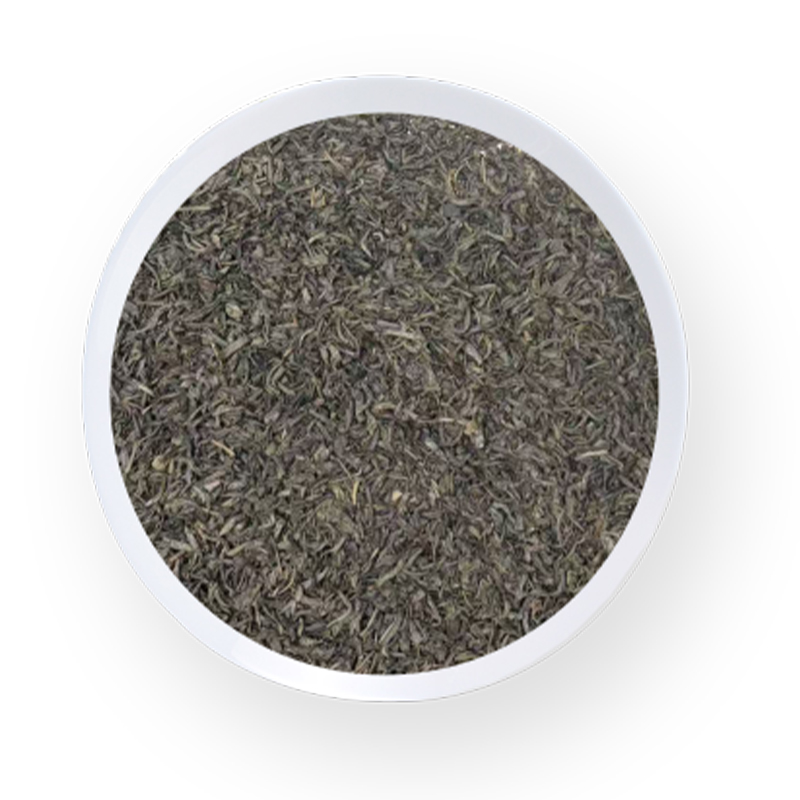 Chunmee 9371Zhen Mei 9371 is a premium grade of Chinese green tea, known for its distinctive "eyebrow-shaped" leaves and rich flavor. Zhen Mei is derived from the Chinese term "Zh...View Product →
Testing a second lot number against a first is the fastest way to judge consistency, and buyers comparing a 41022 grade against a 9371 lot are effectively testing two producing areas at once. Practical guidance on judging leaf appearance and liquor before a laboratory result arrives is collected in this note on how to tell the quality of China green tea, which is worth reading before samples are requested.
Questions Buyers Ask Before the First Chunmee Order
What moisture content should Chunmee be delivered at?
Contract at 7.0 percent (m/m) maximum and aim for 5.5 to 6.5 percent in production, measured by loss in mass at 103 degrees Celsius under ISO 1573. Every additional percentage point above 7 percent shortens safe storage life by months and multiplies the risk of mould in a humid destination port.
Which residue limits apply to Chunmee shipped to Morocco or Europe?
The European Union default maximum residue limit of 0.01 mg/kg under Regulation (EC) No 396/2005 applies where no specific value is listed, with anthraquinone at 0.02 mg/kg. Morocco's ONSSA applies the same 0.01 mg/kg default, so a single lot tested to 0.01 mg/kg satisfies both markets.
How much Chunmee fits in one container?
An unpalletised 20-foot container takes roughly 6,000 to 7,000 kg of tea in 20 kg cartons, and a similar quantity in 25 kg kraft sacks once pallet height is taken into account. Palletising reduces the payload, so buyers who require pallet delivery should plan the order quantity around a 40-foot high cube instead.
How long does Chunmee stay within specification after packing?
Expect 18 to 24 months when the liner is heat-sealed, storage stays below 25 degrees Celsius and relative humidity stays under 60 percent. Beyond 12 months, water extract declines measurably and the liquor loses brightness, so contracts that carry a 12-month shelf commitment should specify nitrogen flushing or foil lamination.
Working with the factory: Hangzhou Baoda Tea Co., Ltd. processes Chunmee, Gunpowder and Keemun at a 12,000 square metre workshop on a 40,000 square metre site in Huangshan, Anhui, with an annual capacity of 10,000 tonnes and regular shipments to Morocco, Algeria, Mauritania, Mali, Senegal, France, Belgium, Spain, the Netherlands and Italy. Lot specifications, sample sets and packaging drawings are agreed and signed off before a contract is placed, which is the only sequence that keeps a 6,000 kg container from becoming a claim.

 We sincerely welcome customers from all over the world to visit us and seek common
development and create brilliant future.
We sincerely welcome customers from all over the world to visit us and seek common
development and create brilliant future.
Contact BAODA
 Our Phone
+86-15386682887
+86-13857173531
 E-mail
[email protected]
[email protected]
[email protected]
 Our Address
Room 1601, Building 2, New Town Times Square, 189 Fengqi East Road, Hangzhou, Zhejiang Province, China.
Inquiry Us Now
Copyright © Hangzhou Baoda Tea Co., Ltd. All Rights Reserved
Wholesale China Premium Green Tea Company
