

 English
  Français
Industry News
How Does the Origin of Chinese Gunpowder Tea Affect Its Flavor and Quality?
1. Geographic and Soil Composition Analysis of Chinese Gunpowder Tea
- The cultivation of Chinese Gunpowder Tea is sensitive to the mineral content, pH level, and organic matter in the soil. Regions such as Zhejiang province exhibit loamy, slightly acidic soils with pH between 5.5–6.5, which favor catechin synthesis and chlorophyll retention.
- Altitude and topography influence leaf morphology. Tea grown at 600–1200 meters demonstrates higher leaf density and reduced surface area, which contributes to a tighter rolled pellet structure.
- Microclimate effects: Humidity, diurnal temperature variations, and solar radiation in misty mountain areas increase polyphenol concentration, enhancing bitterness control and aroma retention.
2. Leaf Selection and Physical Characteristics Impact
- Plucking standards follow the one bud and two leaves method to ensure uniformity. This selection ensures a consistent tensile strength during rolling and minimizes breakage.
- Leaf moisture content is adjusted to 60–65% pre-rolling. Moisture uniformity affects pellet shape consistency and oxidation kinetics.
- Long-tail keyword integration: How brewing temperature affects gunpowder tea antioxidant levels — controlled leaf moisture and shape enhance extractable polyphenols during infusion.
3. Rolling Mechanics and Pellet Formation
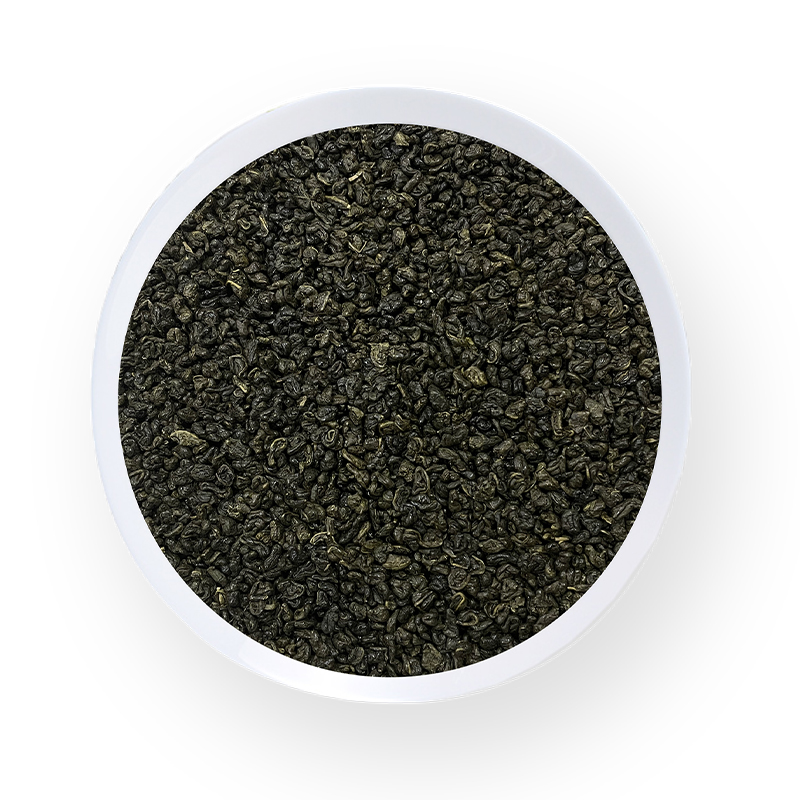
- Rolling methods utilize either mechanical drums or hand-twisting with controlled pressure to form 3–5 mm dense pellets. The applied pressure and rotation speed must be optimized to maintain leaf surface integrity.
- Parameters such as rotation speed (20–25 rpm), pellet diameter, and leaf alignment directly correlate with infusion time and flavor extraction efficiency.
- High uniformity in rolling ensures consistent release of volatile oils, which influence the smoky, nutty aroma characteristic of Chinese Gunpowder Tea.
4. Thermal Fixation and Drying Processes
- Steaming or pan-firing at 180–200°C halts enzymatic oxidation while preserving green pigments.
- Drying reduces moisture to 3–4% to stabilize pellet shape and shelf-life. Temperature ramping rates (5°C/min) are controlled to minimize leaf fracturing.
- Controlled cooling and humidity stabilization prevent rehydration and mold formation during storage.
5. Flavor Profile and Chemical Composition Comparison
Textual comparison of standard green tea vs. gunpowder tea vs. high-altitude gunpowder tea:
- Standard Green Tea: Loose leaf, lighter aroma, polyphenol content 60–75 mg/g.
- Gunpowder Tea: Rolled pellets, robust aroma, polyphenol content 80–100 mg/g.
- High-Altitude Gunpowder Tea: Denser pellets, intensified aroma, polyphenol content 95–110 mg/g, catechin concentration higher by 10–15% compared to low-altitude samples.
| Type | Leaf Shape | Polyphenol (mg/g) | Caffeine (%) | Color |
| Standard Green Tea | Loose | 60–75 | 3.0–3.5 | Bright Green |
| Gunpowder Tea | Rolled Pellet | 80–100 | 3.5–4.0 | Deep Green |
| High-Altitude Gunpowder Tea | Dense Rolled Pellet | 95–110 | 3.8–4.2 | Deep Green with Sheen |
6. Hangzhou Baoda Tea Co., Ltd. Processing Standards
- The company's processing plant in Huangshan city, Anhui Province, spans 40,000 square meters with 12,000 square meters of operational area.
- Advanced rolling machinery, temperature-controlled pan-firing, and automated drying ensure precise pellet formation, moisture control, and chemical composition preservation.
- Annual production capacity: 10,000 tons, exported to Morocco, Algeria, Mauritania, Mali, Senegal, France, Belgium, Spain, Netherlands, and Italy.
- Technical force ensures adherence to ISO 9001 standards, maintaining leaf integrity, antioxidant retention, and consistent flavor profiles.
FAQ
- Q1: How does the origin of Chinese Gunpowder Tea influence polyphenol content?
Tea grown at higher altitudes with loamy, mineral-rich soils shows 10–15% higher catechin concentration compared to lowland regions. Hangzhou Baoda Tea Co., Ltd. selects appropriate origin zones to ensure consistency. - Q2: What is the optimal rolling pressure for consistent pellet formation?
Mechanical rolling at 20–25 rpm with controlled pressure ensures pellets maintain shape without leaf fracturing, critical for antioxidant retention. - Q3: How does pan-firing temperature affect flavor profile?
Maintaining 180–200°C halts oxidation while promoting Maillard reaction notes, enhancing smoky and nutty flavors characteristic of Chinese Gunpowder Tea. - Q4: Can processing impact shelf-life?
Yes, precise drying to 3–4% moisture and controlled cooling prevents mold growth and preserves aroma, extending shelf-life up to 24 months. - Q5: Which long-tail factors influence antioxidant extraction?
How brewing temperature affects gunpowder tea antioxidant levels is critical; infusion at 80–85°C for 3–5 minutes maximizes catechin release.
Technical References
- ISO 11292:2011 – Green Tea (Camellia sinensis) Determination of Caffeine Content
- ASTM D7871-16 – Physical and Chemical Analysis of Green Tea
- GB/T 14456-2017 – Chinese Tea Quality Standard: Green Tea
Chinese Original Green Tea Loose Leaf
Chinese Original Green Tea Mild Taste
Chinese Original Green Tea Fresh Leaves
Chinese Original Green Tea Non Fermented Tea
Chinese Original Green Tea Early Spring Harvest
Chinese Original Green Tea Vacuum Packed
Chinese Original Green Tea For Daily Drinking
Chinese Original Green Tea Traditional Processing
Chinese Original Green Tea Natural Aroma
Chinese Original Green Tea Premium Grade
Related Products
 We sincerely welcome customers from all over the world to visit us and seek common
development and create brilliant future.
We sincerely welcome customers from all over the world to visit us and seek common
development and create brilliant future.
Contact BAODA
 Our Phone
+86-15386682887
+86-13857173531
 E-mail
[email protected]
[email protected]
[email protected]
 Our Address
Room 1601, Building 2, New Town Times Square, 189 Fengqi East Road, Hangzhou, Zhejiang Province, China.
Inquiry Us Now
Copyright © Hangzhou Baoda Tea Co., Ltd. All Rights Reserved
Wholesale China Premium Green Tea Company
