

 English
 Français
Chunmee Tea Processing: Key Factors That Keep Grade Consistency Stable
A 24-tonne container of Chunmee 41022 AAAAAA can fail a buyer's sieve check even when the leaf came from the same Anhui garden that passed the previous season. In most disputes, the cultivar is not the problem. Chunmee grade consistency is decided by five processing variables, and each one can be measured before the container is sealed.
Chunmee tea, written in Chinese as zhen mei, is a pan-fired green tea sold in bulk by tea number and sub-grade to markets including Morocco, Algeria, Mauritania, Mali and Senegal. A 2026 paper in Foods (MDPI, 15(11):1848) identifies cultivar, geographical origin and processing technique as the three main drivers of green tea quality and market value. Processing technique is the only one of the three that a factory can change from lot to lot, which is why grade consistency is a process problem before it is a sourcing problem.
What follows is the working order: what grade consistency measures, which five controls decide it, and what an importer should request before a container is released.
What Grade Consistency Actually Measures
Grade consistency is the lot-to-lot reproducibility of four measurable properties inside one declared tea number: particle size distribution, moisture content, water-soluble extract and sensory profile.
Definition: a Chunmee grade is a declared distribution of leaf particle sizes combined with a declared compositional range. It is not a single sample that looked correct on the day it was packed.
The trap is that a grade is a distribution rather than an average. Two lots can share the same mean particle size and still behave differently on a buyer's line if one carries a wider spread of fine material. A screen test on a drawn sample, not a glance at the top of the bag, is the working standard in export trade.
| Parameter | Reference check | What drifts when it is not held |
| Particle size distribution | Sieve stack analysis on a drawn sample | Fine fraction rises and a lot sold as AAAAAA screens closer to AAAA |
| Moisture content | Loss in mass at 103 degrees Celsius, following ISO 1573 | Dry lots shatter into fanning in transit; wet lots risk mould |
| Water-soluble extract and total ash | Boiling-water extraction and ashing, judged against ISO 11287:2011 | Liquor strength changes and the tea behaves differently in a buyer's blend |
| Colour, liquor and aroma | Comparison with a retained sample under fixed lighting | Visible shading between retail packs, plus aroma splits inside one grade |
A grade is a distribution, not a peak. Two lots with the same average particle size fail the same screen test if their spread differs.
Inside the 41022 family, neighbouring sub-grades differ by a narrow shift in the share of fine particles, tips and evenly coloured leaf. The 41022 grade family is quoted on that distribution rather than on one visual standard, which is why two offers for the same declared tier are often two different distributions.
The Five Control Points, In Order
Final grade is set by five control points held in sequence: leaf intake, fixation, rolling, drying, and sorting with blending. A failure at an early point cannot be corrected by a later one.
- Leaf intake and uniformity. Record moisture and plucking standard for every delivery. Mixing deliveries that differ in leaf moisture is where variance enters the plant.
- Fixation, or kill-green. Inactivate the enzymes behind oxidation inside a documented temperature and dwell window. Under-fired leaf keeps changing colour after drying starts.
- Rolling. Pressure and time decide how much leaf breaks. Heavier rolling raises the fanning fraction and pushes a lot down the tier structure.
- Drying. Two-stage drying reaches a stable final moisture without hardening the leaf surface.
- Sorting and blending. Sieves split the dried leaf into sub-grades, and the blend ratio fixes what the declared tea number contains.
Sieving only separates particles that already exist. If colour and breakage are inconsistent going into the sieve stack, no blend ratio restores a higher tier.
Fixation and Drying: Where Grade Variance Is Created
Fixation and drying move final grade more than any other stage, because both change colour, aroma and breakage at the same time.
Fixation
- Fast enzyme inactivation in the first minutes of firing is the target, not a slow warm-up.
- Under-fired leaf keeps oxidising: the liquor turns yellow and the grade drifts down even when the sieve result is unchanged.
- Over-fired leaf scorches and shatters in rolling, inflating the fanning fraction recovered at sorting.
- Log drum temperature, feed rate and dwell time per lot so a shift can be traced to one hour of production.
Drying
- A hotter first pass plus a slower finish reaches a stable moisture without case-hardening the leaf.
- A lot packed at the top of the moisture window keeps losing mass in transit.
- A lot packed at the bottom of the window becomes brittle and generates fanning during loading.
- Consistency means repeating the same curve, not only hitting the same final number.
Practical rule: hold the same curve across lots, then verify with the same test. One final moisture reading says nothing about how the leaf got there.
Sorting, Tea Numbers and the Limits of Sieve Grading
Sieve sorting sets the ceiling on grade consistency, and blending can average differences between lots but cannot remove them.
Chunmee is traded by tea number: 4011, 41022, 9366, 9371 and 9380 each describe a source and a sieve outcome rather than a single rank on one ladder. The number 9380, for example, is normally the fine fanning recovered while sorting other teas, not a premium tier sitting above the numbered grades.
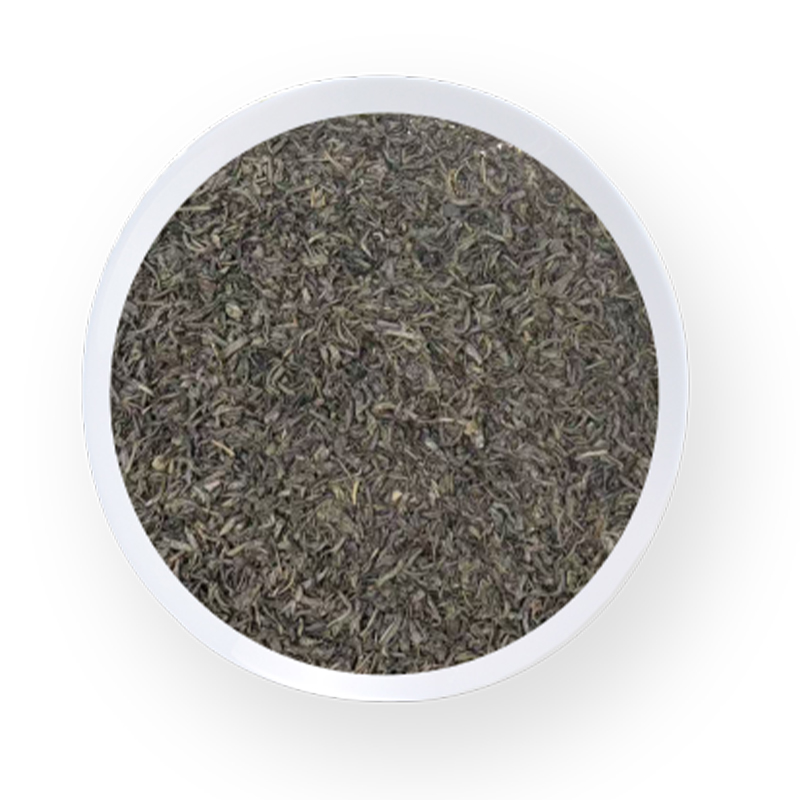 Chunmee 9371 Standard-Grade Green Tea for Private-Label BlendingA spring-flush, pan-fired Chunmee 9371 with specified mesh, low stem and moisture, suited to tea bag filling, instant tea, and private-label blending.View Product →
Blending is where a tea number becomes a recipe. When incoming sub-grades shift, the ratio has to be recalculated against a retained reference, or the shipped lot drifts even though every component passed on its own.
The traditional Chunmee process of pan-firing, rolling, repeated firing and sorting remains the base against which export grades are judged, because a sieve stack cannot see flavour.
Two lots can pass the identical screen test and still differ in liquor strength, astringency and aroma. Physical grading controls size; it does not control chemistry.
Grading Tiers Inside One Tea Number
One tea number can carry seven sellable tiers. In the 41022 family, an exporter may list AAA, AAAA, AAAAA, AAAAAA, AAAAAAA, AAAAAAAA and Diamond, all built from the same base tea.
What separates the tiers is a narrower distribution: a higher share of fine, evenly coloured leaf, a tighter screen result and a lower accepted fanning limit. That is why the top tier is normally quoted against a retained sample rather than against the letter grade alone.
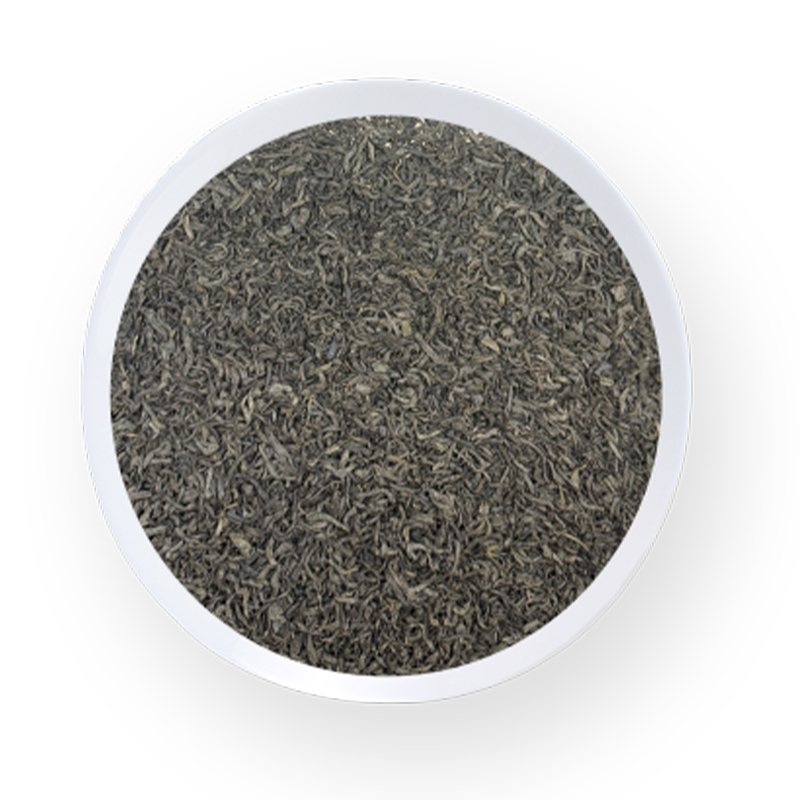 Chunmee 41022 AAAAAA Cost-Effective Green Tea for CateringFor comparing tier separation, this 6A Chunmee uses six extra grading passes, tighter 0.7-1.6 mm distribution, and low stems for tea bags and catering.View Product →
Illustrative Example: those percentages are a modelled split for a hypothetical lot after one firing and one sorting pass. They are not measurements from a specific factory and will shift with leaf quality, fixation curve and sieve configuration.
For a buyer, the useful question is not how many tiers exist but whether one tier can be repeated across three consecutive shipments with the same moisture, screen result and colour.
How Buyers Verify Grade Consistency Before Shipment
Three checks catch most grade drift before a container is loaded: a retained reference sample, a sieve analysis on a drawn sample, and a moisture test on the packed lot.
- Request the retained reference sample from the last accepted shipment and compare it under the same lighting, not in a photograph.
- Ask for sieve analysis on a sample drawn after blending, because the blend ratio is what finally defines the grade.
- Confirm the moisture method: loss in mass at 103 degrees Celsius, as described in ISO 1573, run on the packed lot on packing day.
- Agree thresholds in writing, for example a maximum fanning share and a moisture band, before the first order is placed.
- Test liquor and aroma on that same drawn sample, since size grading cannot detect a change in chemistry.
Instrumental grading adds a second layer. Wu and colleagues, in a study indexed as PMC9913903, reported that near-infrared spectroscopy combined with a fuzzy linear discriminant model classified Chunmee grades accurately enough to separate neighbouring tiers, which confirms grade differences are measurable in the leaf and not only on a sieve. A 2026 study in Food Science and Human Wellness (DOI 10.26599/FSHW.2026.9251014) linked lower Chunmee grades to reduced tea-mucin aggregation, consistent with weaker astringency.
Where a contract names the top of a family, such as Chunmee 41022 Diamond, the retained sample becomes part of the specification rather than a courtesy.
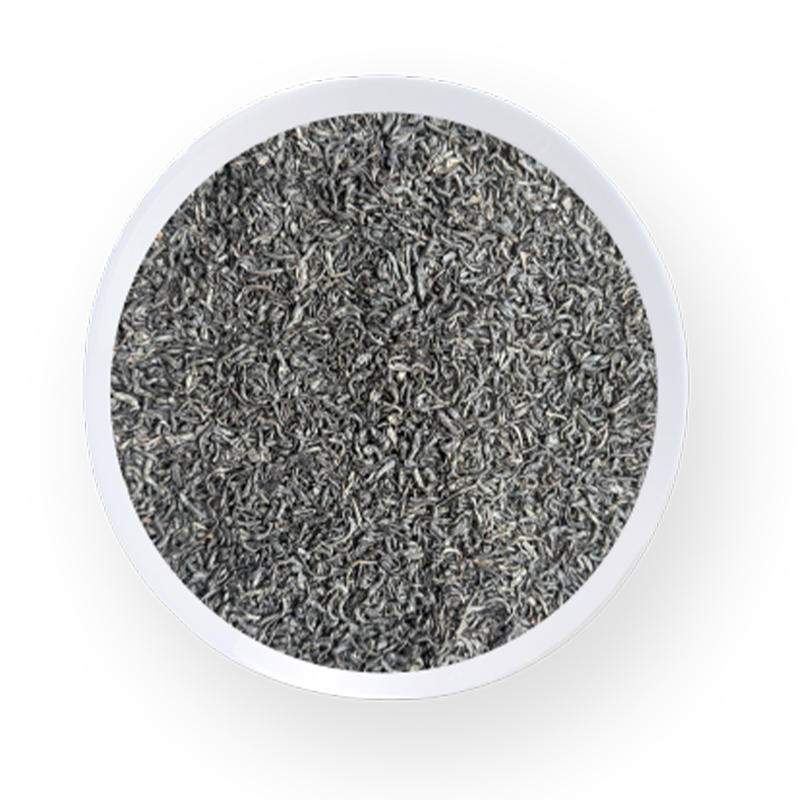 Chunmee 41022 Diamond Organic Premium Export Green TeaHuangshan-sourced, certified EU ECOCERT Organic and cleaned electrostatically for clearer liquor and less sediment in premium export blends.View Product →
Capacity only helps consistency when the same control windows apply to every lot. Hangzhou Baoda Tea Co., Ltd. processes on a 40,000 square metre site in Huangshan, Anhui, with 12,000 square metres of buildings and a stated annual capacity of 10,000 tonnes. At that volume the practical limit is documentation: temperature logs, sieve reports and retained samples that trace one container back to one production day.
Direct Answers on Chunmee Grade Control
Why does the same tea number taste different between shipments?
Because a tea number fixes particle size, not chemistry. Two lots of 41022 AAAAAA can pass the same sieve analysis and still differ in astringency, as the 2026 tea-mucin work in Food Science and Human Wellness indicates. Buyers who need repeatable liquor should specify a retained sample alongside the tea number.
How many control points must a factory hold?
Five: leaf intake, fixation, rolling, drying, and sorting with blending. Holding four of the five leaves the remaining stage as the source of drift, and drift at fixation or drying appears as colour and aroma variation that no sieve can correct.
Can blending repair an inconsistent base tea?
No. Blending averages differences between components, it does not remove them. For example, if one incoming lot carries 22 percent fanning and the next carries 28 percent, a fixed blend ratio produces two shipped distributions that differ by the same margin.
What should a buyer put in the contract?
A retained reference sample, a particle size range checked by sieve, a moisture limit verified by the ISO 1573 loss-in-mass method at 103 degrees Celsius, and a fanning ceiling. Written thresholds settle disputes faster than any laboratory upgrade, because they define the point at which a lot is rejected.
 We sincerely welcome customers from all over the world to visit us and seek common
development and create brilliant future.
Contact BAODA
 Our Phone
+86-15386682887
+86-13857173531
 E-mail
[email protected]
[email protected]
[email protected]
 Our Address
Room 1601, Building 2, New Town Times Square, 189 Fengqi East Road, Hangzhou, Zhejiang Province, China.
Inquiry Us Now
Copyright © Hangzhou Baoda Tea Co., Ltd. All Rights Reserved
Wholesale China Premium Green Tea Company
