

 English
  Français
 Premium Jasmine Tea: Scenting Rounds, Quality Checks and B2B Sourcing Guide
When a tasting panel in Casablanca pours two jasmine teas side by side, the cheaper lot smells promising for the first two minutes. By the third infusion its floral top note collapses into a thin, grassy tail, while the premium lot, scented three additional rounds, still carries jasmine through the fifth cup. Buyers who read that gap stop overpaying for labels and underpaying for process.
What Makes Jasmine Tea Premium Is the Process, Not the Label
Premium jasmine tea is a process claim, not a packaging claim: the quality ceiling is set by the number of scenting rounds, the ratio of fresh flowers to tea, and the grade of the green tea base, not by the volume of dried petals visible in the pouch.
Jasmine tea in the Chinese export tradition starts with a green tea base, usually a fine-grade leaf from Anhui, Sichuan or Fujian, that is dry but porous enough to absorb volatile aroma compounds. Fresh jasmine blossoms are layered with the tea in scenting chambers; the flowers open at night in warm weather, releasing aroma that the trapped leaf absorbs over six to ten hours. The spent flowers are sieved out, and higher grades repeat the cycle. Traditional scenting centers in Guangxi's Hengxian and Fujian's Fuzhou still define the benchmark, and export processors follow the same discipline at scale. Hangzhou Baoda Tea Co., Ltd., a processor and exporter whose 40,000 sq m plant in Huangshan, Anhui handles the full line, sources base teas and runs scenting cycles in this same production model.
Core definition
Scenting is the traditional Chinese method in which fresh jasmine blossoms are layered with dried green tea overnight so the leaf absorbs the flowers' volatile aroma. Spent flowers are then removed by sieving, and the cycle is repeated for higher grades.
| Grade tier | Scenting rounds | Flowers per 100 kg tea | Aroma life |
| Foundation grade | 3 | 45 kg | Fades by cup 4 |
| Commercial premium | 5 | 65 kg | Holds to cup 5 |
| Export superfine | 7 | 80 to 100 kg | Recognizable to cup 6 |
Fresh jasmine blossoms used to scent 100 kg of green tea, by export grade
The flower-to-tea ratio explains the price ladder better than any marketing term. A 100 kg lot scented at 65 kg of flowers carries roughly 40 percent more floral material than a 45 kg foundation lot, and the aroma compounds sit deeper in the leaf, which is what makes higher grades hold flavor over more infusions.
Five Sensory Checks a Buyer Can Run on a Five-Gram Sample
A five-gram sample is enough to expose the difference between a genuinely scented tea and a tea that has been sprayed with synthetic floral flavor, provided the leaves are read deliberately.
Professional buyers rarely rely on the first sniff. They evaluate across time and across infusions, because absorbed aroma behaves differently from surface fragrance. The checks below mirror the routine that tea importers in Europe and North Africa use before they commit to a container.
- Dry leaf aroma: hold the pouch opening close to your nose; a sharp, almost alcoholic floral hit that fades within seconds suggests a sprayed flavor, while a clean, low-key floral note signals absorbed scent.
- Third-infusion persistence: true scenting lives inside the leaf and re-emerges in later brews; sprayed lots lose 60 to 70 percent of their top note by steep three.
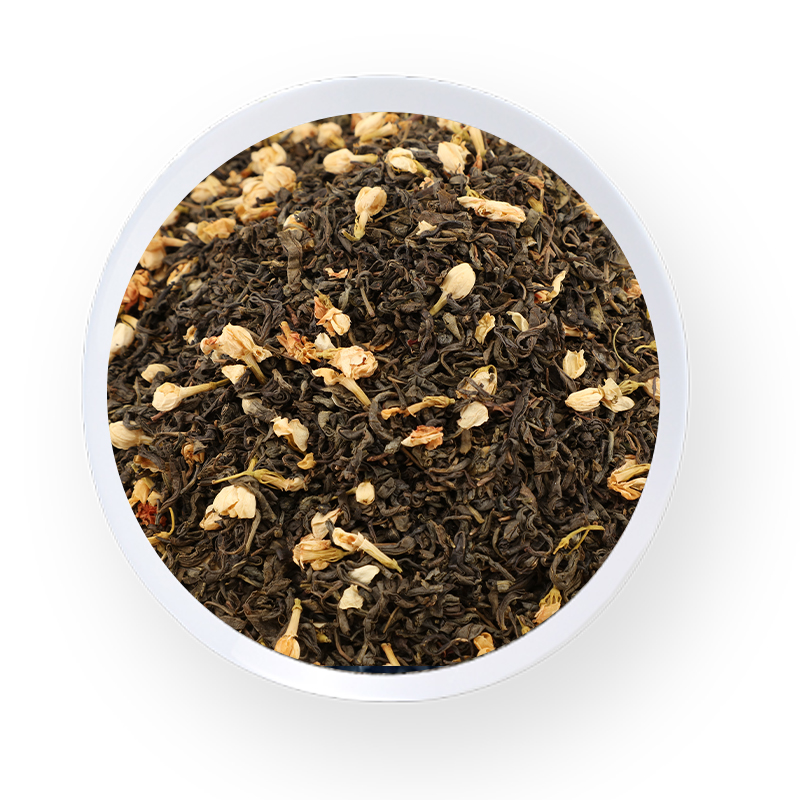
- Leaf appearance: mostly whole, uniform leaves with few broken bits and no added petals, because petals left in the final tea carry moisture and shorten shelf life.
- Liquor clarity: a bright, pale-yellow infusion indicates clean processing; cloudiness points to dust, over-firing or careless re-drying.
- Finish and huigan: a sweet, coating aftertaste in the throat is the signature of a fine green base, while a rough astringent tail usually means the base leaf was traded down.
For a more complete analysis of how to read a sample, including how base-leaf grade and growing region change the result, cross-reference this guide to choosing Chinese jasmine green tea for flavor and quality.
B2B Sourcing: What to Verify Beyond the Sample
For container-sized orders, consistency across batches and documented compliance matter more than an impressive single sample, because scenting is seasonal and every lot varies.
10,000 t
annual production capacity
40,000 sq m
processing site in Huangshan
12,000 sq m
covered workshop area
Seasonality and calendar risk
Jasmine blossoms reach peak oil content in July and August, when night temperatures are high enough for the flower to open fully. Premium lots scented in that window sell first, so buyers who lock in allocations before the end of the third quarter avoid late-season premiums or accept thinner aroma.
Compliance and packaging
Export jasmine tea must clear pesticide residue limits that differ sharply by market; European buyers should request residue documentation aligned with Regulation (EC) 396/2005 before signing. Fresh flowers raise the moisture of the finished tea, so a reputable processor re-dries to 5 to 6 percent moisture and seals within 24 hours. A lot that smells floral in the warehouse but arrives dull in Europe usually failed at drying or packaging, not at sourcing.
Sample-stage checks
- Single-lot sensory pass on the five checks above
- Moisture content at or below 6 percent
- Aroma still present at the third infusion
- No visible petals or broken leaf dust
Container-stage checks
- Batch-to-batch aroma consistency across lots
- Residue documentation per export destination
- Airtight, food-grade packaging with moisture barrier
- Shipping terms that protect aroma in transit
The deciding test for an export lot is stability: a premium jasmine tea keeps its identity from the first tasting to the last cup of a shipment, because the scent is stored inside the leaf structure, not painted on the surface.
Baoda's jasmine line sits inside the full export product catalogue, where the same factory that handles bulk green tea grades executes scenting and packaging under one roof. Buyers can request current crop parameters, residue support and pack size options directly from the jasmine tea export specification page.
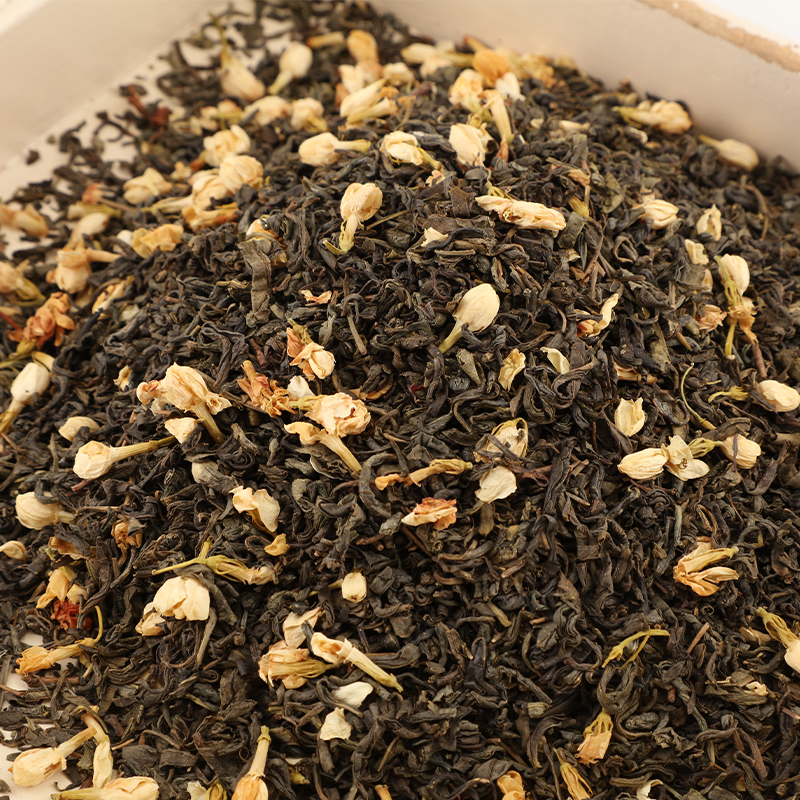 Chinese Organic Jasmine Green Tea, Premium Jasmine Tea CompanyHangzhou Baoda Is Chinese Organic Jasmine Green Tea Suppliers, Premium Jasmine Tea Company, We Wholesale Private Label Premium Jasmine Te...View Product →
How to Brew-Audit a Quotation in Four Steps
Every quote should be brewed the same way, with fixed grammage, fixed water temperature and fixed time, so comparisons across suppliers stay meaningful.
- Weigh 3 grams of leaf into a 150 ml gaiwan or cup; do not sieve the sample, because breakage is part of the grading.
- Pour water at 80 to 85 degrees Celsius; hotter water makes the green base bitter and masks the floral note.
- Steep for 2 minutes for the first cup, then re-steep the same leaves twice more at 3 minutes each.
- Judge the third infusion as the deciding round; true scenting survives it, while sprayed and poorly absorbed fragrance does not.
Score each cup separately: aroma at the nose, sweetness on the finish, astringency on the tongue. A premium lot rarely scores below 7 out of 10 on the third steep; a commercial lot usually drops to 5 or lower, and that gap is the real price difference.
Frequently Asked Questions
Four questions decide most jasmine tea purchase decisions, and the answers apply consistently across export markets.
Is more scenting always better?
Not linearly. Beyond seven to nine rounds, the gain narrows unless the base leaf is fine enough to absorb and hold the aroma, so most export lots stop at five to seven rounds, where the flavor-to-cost ratio is strongest.
Are jasmine petals in the tea a sign of quality?
No. Traditionally the spent flowers are removed after each scenting round. Petals left in the final tea usually indicate lower grades or added visual bulk, and they raise the moisture risk during shipment.
How long does premium jasmine tea keep its aroma?
12 to 18 months in airtight, food-grade packaging at stable temperature, and longer under 0 to 5 degrees Celsius cold storage. Once the pack is opened, the top note begins to fade within weeks.
Can jasmine tea be customized for retail or foodservice formats?
Yes. Export processors can adjust leaf grade, pack size, inner liner and even the scenting depth, as long as the base-leaf specification and residue documentation are defined in the contract.
The label sells the story; the third infusion tells the truth. Confirm scenting rounds, flower ratio and moisture on paper, then confirm with the cup.
 We sincerely welcome customers from all over the world to visit us and seek common
development and create brilliant future.
We sincerely welcome customers from all over the world to visit us and seek common
development and create brilliant future.
Contact BAODA
 Our Phone
+86-15386682887
+86-13857173531
 E-mail
[email protected]
[email protected]
[email protected]
 Our Address
Room 1601, Building 2, New Town Times Square, 189 Fengqi East Road, Hangzhou, Zhejiang Province, China.
Inquiry Us Now
Copyright © Hangzhou Baoda Tea Co., Ltd. All Rights Reserved
Wholesale China Premium Green Tea Company
